Showing posts with label creativity. Show all posts

  • Montra For Your Class? Published 2009-06-09 under ,

    libeskind contemporary jewish museum I love to apply ideas from other industries to our education space. Here is one from the architectural world.

    Architect Daniel Libeskind talked about how he tried to make his work expressive rather than neutral, unexpected rather than habitual, memorable rather than forgettable, communicative rather than mute, democratic rather than authoritarian. What if our classrooms were expressive rather than neutral, unexpected rather than habitual, memorable rather than forgettable, communicative rather than mute, democratic rather than authoritarian?

    Contemporary Jewish Museum

  • The Zen of Cutting Paper Published 2009-03-25 under ,

    peace Given the choice of clip art or scissors with construction paper, which would you choose to create your next presentation? Read on to hear the story of one presentation where this technologist decided to go "unplug".

    You are asked to create a presentation on 21st Century Skills to be given to the school board next week. Your first step ... sit down at the computer, fire up PowerPoint or Keynote and get stared! OK, we are educators. We know that this approach is a bit hasty. We need a plan.

    Being the presentation guru, you outline the goals of the presentation and key points that you want to convey to your audience. You then outline the approach - decide what you are going to say. Finally you think about the content remembering that each slide (the visuals) should enhance what you are saying.

    After you have the plan, you return to your computer and begin crafting the presentation. This is where I took a different path in a recent presentation. Normally I follow my traditional method - opening Fireworks, developing a visual template, and filling each page/slide with text/images according to my outline. [note: I use Fireworks instead of Powerpoint as it gives me better control and more options. When done, I usually output the file as a PDF.]

    This time, I took a few of my daughter's coloring books (with permission of course) and found images consistent with my plan. I cut these images out and glued them to pieces of large construction paper. The process of cutting and gluing was much more satisfactory than moving the mouse around the screen. It also allowed me to enlist the help of my daughter - her condition for using her coloring book. I had a great time working with her and the end product was unique. The presentation went over really well and they all loved my "mystery slide" that I through in. It was the page Ruby constructed on her own with her favorite pictures. While it did not tie directly into the topic, it was a source for humor as the audience tried to guess its relevance.

    The next time you give a presentation, or better yet, you assign your kids to create a Powerpoint, consider the low tech solution. We did this in a recent tech ed forum and the results were fantastic.

  • It's OK to See a Movie Published 2009-01-19 under ,

    summary thumb How can you tell me that going to a movie will make me a better educator?

    I have been a fan of the Sundance Film Festival for a long time but never could attend. January was a very busy time for me - my classes were finishing the semester and preparing for exams, the soccer program was in full swing with league play underway, and I was meeting with my department members going over their reviews.

    When I left the classroom, I vowed to keep January open so I could attend Sundance. My expectations were certainly met and even surpassed. Every year (since 2001), I have been going to Sundance except those years when my two children were born. This year, however, I could have gone, but due to several factors - mainly upcoming commitments - I am not attend the festival.

    Instead, my friend and I have created the Bill/Rob Film Festival where we are spending the week going to one, two or even three movies each afternoon. At first, I felt the need to justify this: "I am working extra hard in the mornings and at night so I can go to the movies". But why? Isn't it OK for me to see a movie?

    Yes, you are correct. This is more than just one movie. But it does reflect on a condition that we as Americans especially suffer from. We feel that unless we are busy, working hard all the time, we are not being successful or "contributing". This summer, I read Tim Ferriss' book "The 4-Hour Workweek". In it, the author relates a time when he worked at a job that required him to make sales calls to executives. He found that if he spent an half-hour in the early morning and an hour in the evening making calls, he was more productive (and overall more successful) than his counterparts who spent eight hours calling. The reason: he called either before the the executives' personal assistants got to work or after they had left. These personal assistants were screening the calls and protecting their bosses from the likes of the author.

    The obvious take-away from this is: "Work Smart, not Hard". But I really focused on the author's other message, namely that even though he was bringing in the business, he was seen as a slacker since he did not make any calls during those other hours. His bosses were short sighted, as many of us are. We tend to encourage those who work hard without really looking at what they are doing and if they are really just spending those hours being busy or are they really doing something.

    Well, back to the Bill/Rob Film Festival. Certainly, if we can get our work done before the films, we should be OK. But I would say that going to these movies will help us work better.

    A big part of my passion involves creativity and as Frans Johansson explains in the "Medici Effect: What Elephants and Epidemics Can Teach Us About Innovation", we need to surround ourselves with new ideas and novel ways of expressing these ideas. Movies help in this end.

    Finally, going to a movie is fun and setting up our own film festival promises to be a blast. Isn't it OK to have some fun?

    Followup - We are still working on the schedule for the week and I will update this post with what we saw and how we like / dislike each. But if you have not seen "Slumdog Millionaire", I would certainly recommend it. Also, Sean Penn is fantastic as Harvey Milk in "Milk".

  • Wish for a Successful Year Published 2008-08-20 under ,

    wishing tree With the start of school around the corner, what are some of your hopes for this new school year?

    I was astonished to learn that my nephew will be starting school tomorrow! It just seems so early; summer has really whizzed by. But it was not my nephew's return to the classroom that got me thinking about the coming school year.

    Monday, I was taking my early morning walk with my little boy and happened upon the wishing tree project here in Pasadena. It is part of Yoko Ono's Imagine Peace project and includes about 20 trees planted in barrels and hundreds of little tags tied to the branches with wishes. Anyone can come by and write his/her wish and attached it to a tree.

    There are thousands of wishes and while many are what you expect (world peace, money, etc.) there are some that really caught my eye. Here are a few:

    On Monday, one particular wish captured my attention but I did not have my camera. I returned today and spent over an hour reading the wishes. You can see a slideshow of my favorites at http://tinyurl.com/pasadena-wishing-tree.

    Unfortunately, I never found the tag that originally caught my attention. It read: "I wish I do well in calculus this year." I had forgotten how the end of summer and the looming start of a new school year brings out anxieties. Whether it is a particularly scary course or teacher, the start at a new school, the return of the bully, or just the book(s) you did not read over the summer, the end of August can be a time of worry.

    So here is wishing all of you a wonderful and scary-free school year.

    Tech Tags:

  • NECC: Intel - Best of Show Published 2008-07-02 under , ,

    iste My pick for "Best of the Show" - Intel's FREE thinking tools.

    Exhibit halls at conferences don't usually excite me. They are noisy, crowded, and with every vendor designing their booth to capture your attention, it is easy to become overwhelmed. Despite my feelings (and my better judgment) I venture into the hall every conference and usually leave with very little. This was the case yesterday at NECC. I did have a nice conversation with the folks at Adobe, met a friend of a friend at TI and was amused by the varied and creative methods being employed to grab ones attention. But, as usual, when I turned to leave, I had nothing to show for my time. Or, that as until I happened by the Intel booth on the way out.

    Why would I stop at the Intel booth? Don't get me wrong - I like Intel and their products. I just have never looked to Intel for educational tools or resources. Well, that has now changed. I am so excited about Intel's Education Initiative and their tools for K-12 teachers.

    The tools are divided into two categories - "Thinking Tools" and "Productivity Tools". Right there, you got to get excited by the title "Thinking Tools". Within this first category, there are three tools: "Visual Ranking Tool", "Seeing Reason Tool", and "Showing Evidence Tool". Again, just from the names, you can get a feel for how these tools might be used for challenging your students with higher learning skills.

    The Visual Ranking Tool is the one that Vanessa (an educator from Austin in the day, Intel Education Leader at night) demonstrated for me and the tool that got me so excited. The tool is quite simple. Teachers setup a list of items and students (working in teams or individually) rank order the items based on some criteria. For example, you could list factors/events leading to WWII and have your students rank order them in terms of their relative importance in causing the war. You could list various reasons why an author killed off a character in a book the class is reading then have your students rank order them based on their plausibility. The tool need not be limited to open-ended type questions. The Ranking Tool could be used to put things in chronological order. In Mathematics, students could be asked to put the steps necessary to solve a problem in their correct order testing their understanding of the concepts and terminology rather than just whether they can perform the math.

    Simple ranking is of no use unless students are required to backup their decisions with some rational. The tool provides a place for students to justify their rankings and then when they are done, they can see how other teams/students ranked the items. This gives the kids a chance to reflect on their ranking and discuss if they should make any changes. It also provides for a good class discussion as students defend their ranking.

    The Visual Ranking Tools alone is a powerful learning tool. And the other tools provided compliment and even extend its ability to get students thinking at a higher level. With all of the fancy tools and technology offered for educators, these relatively simple tools are my pick for the best of the show. They give quality educators the power to get their students thinking!

    Tech Tags:

  • Teacher Learner: We Must Also Learn Published 2008-05-21 under , ,

    One of the most rewarding moments in teaching for me was when I had the opportunity to tutor a student in Algebra II.

    One of the most rewarding moments in teaching for me was when I had the opportunity to tutor a student in Algebra II. My approach was fairly simple; each afternoon I would have him teach me the topics addressed in his class that day. I was teaching Algebra I then and was not necessarily familiar with the topics of his class. Thus, his efforts to teach me were not just a trick, I was learning (or re-learning) the topics.

    My approach forced the student to reflect on the topics which in itself is a powerful teaching tool. But I would offer that my role as learner and the respect I showed to the student's teachings was a principal component behind the success of our tutoring experience.

    I have been reading about the use of case studies as a teaching method and came across an essay by Charles Gragg titled "Teachers Also Must Learn". His basic premise is that the best teachers exhibit a attitude of being willing to learn from their students.

    The teacher who has given up the art of learning from his students should also give up the practice of learning.

    ... how can he lead his students to undertake for their own parts the creative interpretation of knowledge? The answer lies in part at least in the ability of the teacher to listen to his students, not with a view to appraising them, correcting their mistakes, and filling in the gaps in their knowledge, but rather in the constant and true expectation of learning something.

    from Teaching and the Case Method: Text, Cases, and Readings

    Boy, if I think how I listen to my students, it is almost always with the air of the learned one ("the teacher") and infrequently as the one trying to learn. This could be explained by egotism, lack of confidence, lack of respect for the student, or just a traditionalist view of the relationship between teacher and student.

    This points out the how important the art of listening is to the successful teacher.

    The funny thing is that I started this blog with two purposes: an opportunity to reflect on ideas and to learn from this community of educators. Why shouldn't I expect to learn from students as well?

    Tech Tags:

  • Just Remember: + C Published 2008-05-07 under ,

    It's AP time! And today is Calculus Day! All that work has come down to just one test. Derivatives, integrals, Riemann sums, rate of change, area of an object. Some memorization and a whole lot of problem solving. You have spent a year preparing your students and now they are on their own, hopefully with a working graphing calculator, new batteries, and a good nights sleep behind them.

    Wait a minute... Did you tell them to remember the +C? Or more importantly, will your students remember?

    For those non-Calc teachers, most answers to questions involving an integral include a +C (plus some constant). Often, this little item will earn a point for a student on the free-response section, or more accurately, a student will loose a point even if her solution demonstrates complete understanding of the math behind the question (sans the +C).

    I was constantly trying to think of ways of getting my students to remember the +C. I tried the stick; I marked a solution totally wrong if it did not include the constant. I tried the carrot; I gave bonus points to students who spotted a missing +C in class work. (Students quickly learned to game this approach.)

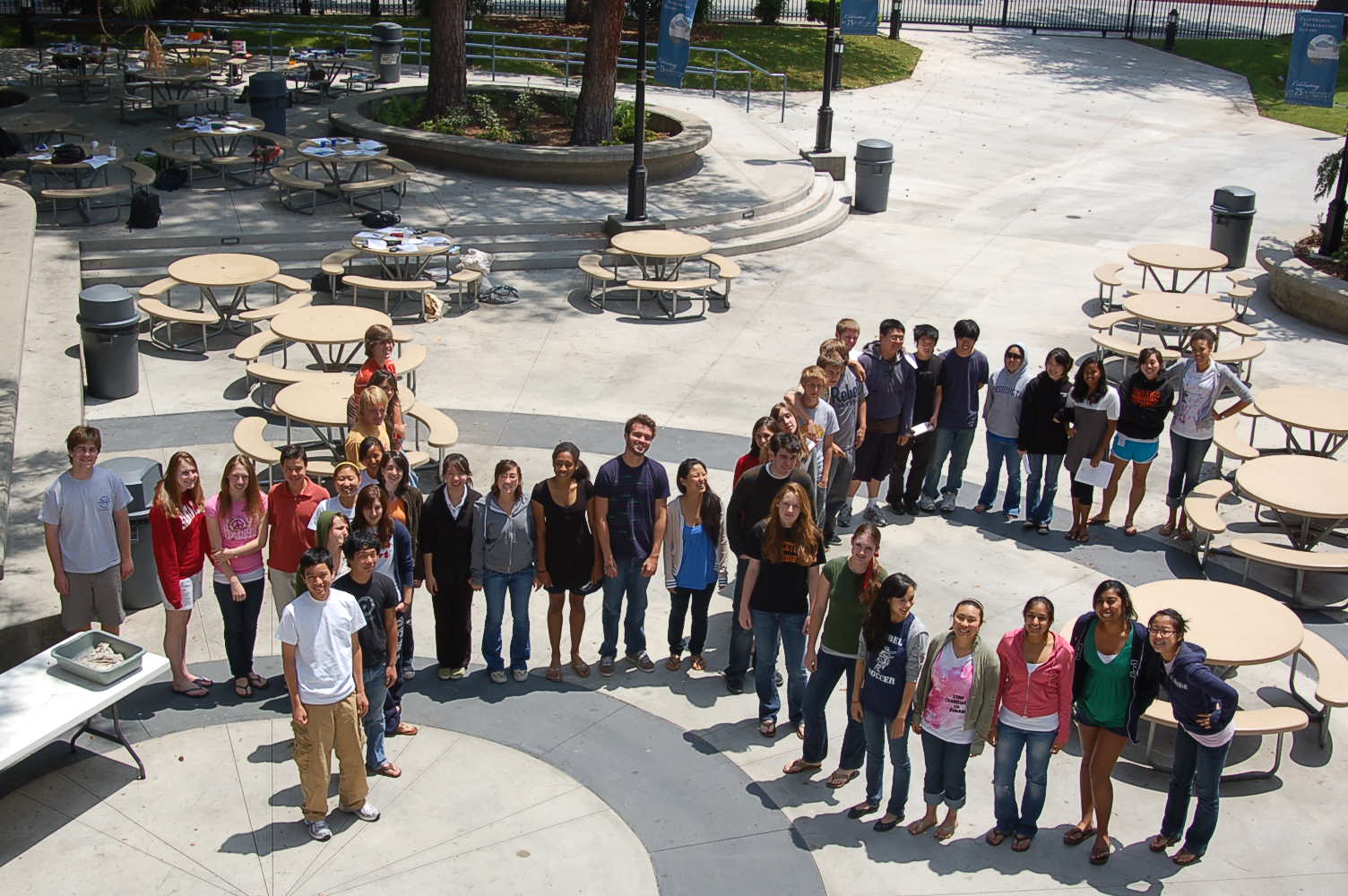
    A friend of mine has taken a totally different approach. He gathered all of his Calc students and took the picture below. Well Done! What a fun way to remind the students of the importance of +C.

    Tech Tags:

  • Defining Success Published 2008-03-14 under , , ,

    After finding a nice place to gather the kids, teacher Monica explains that today's art project will be to create a cow from coffee filters, yarn, and surrounding grass. She holds up an example, passes out the supplies and gives each child a cup to collect their grass.

    The kids get to work and with the direction of their parents, some good looking cows emerge. Ruby, on the other hand, pours mounds of glue, slaps a filter down and pours more glue. Her father looks on observantly but offers no guidance. The result is very much unlike the initial example, receiving comments like "it's certainly abstract."

    Reflecting on this class, I realized just how much we as teachers, parents, and adults define success for our children instead of letting them define their own success. For Ruby, success was pouring the glue and sticking different types of materials together. Success was defined in the process, not in the end product. I will admit that I wanted her to make a cool looking cow and it was difficult to restrain myself from making casual comments like "shouldn't the head be attached to the body?" But, this was not about me. This was not about teacher Monica. It was about Ruby. And we adults needed to get over our personal definitions of success and let the kids explore, learn, and define their own goals.

    Later, Ruby and I were throwing a ball to each other. I found myself saying "good throw" when the ball came to me and "good try" when it didn't. It never occurred to me that for her, success might have been seeing how far the ball would roll after throwing it. In this scenario, throwing it to me would be a failure as the ball would not go as far.

    In the classroom, we define all student success. Everything is held to a standard set by us (or perhaps the state). Are there opportunities for students to define their own success? What would an assignment look like that provided for student defined success? Could students handle such an assignment? What would they define as a success - would it be so simple as to not provide for any learning or so complex as to be impossible to obtain?

    This idea of empowering students has great appeal to me but the pragmatist side of me recognizes the challenges. What are your thoughts?

    By the way, I love Ruby's cow.

    Tech Tags:

  • Pop!Tech Live 2007 Published 2007-10-17 under , , ,

    Pop!Tech Logo A network of remarkable people, extraordinary conferences, powerful ideas & innovative projects that are changing the world.

    If you love TED, then check out the POP!Tech conference in Camden, Maine and online. I am especially interested in listening in on the Thursday session titled "A WHOLE NEW MIND" featuring among others Daniel Pink whose book of the same title confirmed many of my values regarding education, the importance of creativity, collaboration and story. Find some time Oct 17 through 20 to watch and participate in this promising conference.

    Tech Tags:

  • Mashups for Everyone Published 2007-08-09 under , ,

    Thanks for a del.icio.us bookmark from Bud Hunt (aka Bud the Teacher), I found a very interesting article from Wired discussing the problem with social networking sites like Facebook and MySpace. In summary, these services allow users to put information into their pages but do not provide a open architecture (an API) that allows the information to flow out of the page.

    I am a big fan (if you did not already know) of open systems and APIs that allow the sharing of information between services. Admittedly, I am not a Facebook or MySpace user so I just assumed these Web2.0 pillars of social networking provided a means for sharing information outside their own platform. For my money, a defining characteristic of a Web2.0 service is the ability to share information with other services (the availability of an API). Shame on sites that shun APIs.

    The article included a side bar link to an article on how to "Replace Facebook Using Open Social Tools". This is definitely worth a read as it is a great summary of the open services that we can mashup to form interesting new sites.

    If you have never tried creating a mashup or have never used an API, use this article as a guide to get your feet wet with Open Social Tools. You will marvel how easy it is to create a sophisticated page that draws information from a number of sources. When you are done, share your work with me. I'd love to see what you create.

    Tech Tags:

  • Value of Homework in this "Connected" World Published 2007-07-12 under

    I love how various apparently unconnected discussions or events can inspire me to explore new ideas or questions. Recently, several events have left me questioning our use, at least our expectations, of homework.

    First, I spoke with a doctor who was lamenting that his son did not get into the independent school in which my wife teaches. After overcoming the fear that he was going to take the rejection out on me during the exam, I began probing as to why he was interested in changing schools. His son, after all, was attending school in a very desirable district. Among his reasons was that his son was not getting enough homework.

    The other day, I was reading an article from a self-proclaimed marketing guru on how we are moving into an age of distraction. In "The Attention Age Doctrine", the author describes how we are assaulted on a daily basis by a flood of distractions that have limited our attention on any one task to minutes (or even seconds). In this age, it is the person who can remain focused and filter the distractions who will stand out.

    Finally, I just completed watching Guy Kawasaki's panel discussion with a group of young adults (15 - 24 year olds) on their use of technology. [view video] This is an entertaining and insightful look into how technology is an integral part of these "kids" lives. A few take-aways include the number of text messages they make each month (for some it was over 4,000), the importance of the web for their entertainment, communication, and homework, and the degree to which each is constantly connected with others.

    All of this can be viewed in the context of the homework we assign and our expectations vs. the reality of the experience our students are having doing this homework. "Read Chapter #3" is a typical homework assignment, but what are our real expectations. Do we just want our students to familiarize themselves with the topics in the chapter so that during class, it won't be the first time they were exposed to the topics? Perhaps we are asking them to read so that they may return to class prepared to contribute to a class discussion. Do we expect them to be thoughtful about what they are reading and reflect on it?

    Regardless of our expectations, we should not be surprised that many of those who actually do the reading are doing it while exposed to numerous distractions. While many argue that our students are accomplished multitaskers, I question the true productivity of all this multitasking. What if you could make a deal with your students that you would cut the amount of homework you assign in half in exchange for them devoting uninterrupted time (free of all distractions) to the assignments? Do you think your students would get a richer learning experience, albeit with less work?

    I don't know the answer, but would love to hear from anyone that has tried this. You could market this as "Half the Homework, Double the Learning" from the "less is more" principle. Let me know how it works.

    Tagged:

  • Mind on Math Published 2007-07-06 under ,

    MIND Institute I had the most wonderful opportunity this week to meet Ted Smith, the Chairman and CEO of the MIND Institute, and was fascinated with the work of his organization. They produce games that help students succeed in math.

    I can hear you say it now: "Not another math game!". Hold-on. These games are different. First of all, they grew out of over 30 years of academic research into brain function and learning. Second of all, they have a track record of success with six years of consistent 15-20 percentile point improvements on the California Standards Test (more...).

    But the biggest difference is that these are not your typical drill and practice math games. They are engaging and challenging. I just spent over an hour going through some of the demos with my 10 year old nephew. Most of the time was spent on the "Challenge Puzzles" which are great. Be careful, these are addicting and are not easy (my nephew had to help me on a few).

    For me, the most impressive aspect of the games is that they begin with no words or symbols. They teach a concept without the confusion of mathematical terminology or long explanations. They also focus on problem solving. I love how they challenge students to think and not just recite or memorize. These games are designed to be a part of a traditional math curriculum (not replace it) and I cannot imagine a teacher or principal who would not jump at the opportunity to include them in their school.

    I asked Ted if he referred to the MIND Institute's tools as games or something more appealing to educators like "simulations", "tutorials" or "learning modules". He indicated that he has always insisted that they be called games because they are fun. Just because something is fun does not mean that it is not important or productive.

    For many, games are considered frivolous and not part of a real learning environment. We can all agree that much of our learning as toddlers was through games. We may through a game show like activity in here or there. But for the most part, games are viewed as entertainment and not part of education (as if the two are mutually exclusive). Marc Prensky writes extensively about this topic. Recently, I have been looking to Mark Wagner for insight on the topic of games in education. He is doing a great job summarizing the research and actual implementations of this field.

    If you have not seen the work from The MIND Institute, take a look and good luck on their challenge puzzles. I hope these games will help convince you that there is a role for games in education.

    Tagged:

  • Popfly is SO cool! Published 2007-05-21 under , , ,

    This morning I came across a service/website created by Microsoft called Popfly. From the website, "Popfly is the fun, easy way to build and share mashups, gadgets, Web pages, and applications." Popfly consists online visual tools for building mashups without programming experience.

    Our team's vision is to democratize development by making it approachable to an entire class of people that want to "create" without necessarily having to write code. We believe that if you can send an email, you should be able to build and personalize your own website, mashup, social networking site, or blog.

    This project is still in an Alpha release, but it is really cool and offers wonderful opportunities for educators. The downside, it only runs on IE (6.0 +) and Firefox (2.0 +). Nonetheless, check out the Popfly screencast. You will be amazed.

    Technorati Tags:

  • Boring Workshops Published 2007-05-17 under ,

    I just finished a week of attending various workshops put on by the Foundation Center and despite the quality of the material presented I could not help but to notice the lack of creativity with which each presenter approached his/her lesson. You can probably guess the outline:

    1. Speaker Bio
    2. Goals of the Session
    3. Historical Perspective
    4. Overview of Current Practices
    5. Linear Examination of the Details
    6. Conclusions

    Now, there is nothing wrong with this approach. Throw in a few anecdotes and exercises, you have a traditional workshop. But is this the only approach or even the most appropriate approach? What assumptions are made that make this the most popular approach?

    Let's start by examining the practice of stating your goals right at the beginning. It certainly makes sense. If I am going to battle 2hrs of rush hour traffic to attend a workshop, I would like to know what I am going to get out it. But providing motivation is much different than stating goals. I have often wondered how many of my students ever actually read the list of goals that appear at the beginning of every chapter in their textbook. For me, this list is to be consulted after reading the chapter so I can check to be sure I got all that I was suppose to from the reading. In reality, I expect that the list is completely ignored.

    Another assumption that is often made is that a linear presentation of the material is the best way to convey the concepts of the lesson. This is certainly a tried and true approach. But for me as well as several of the other attendees at these workshops, the approach left us wanting more. We agreed that a more hands on, exploratory, approach would have been better. Sitting and listening to the presenter works for a while, but soon it looses it appeal and its effectiveness.

    So, why do presenters and teachers resort to such a teacher centric approach to a lesson? It is harder to come up with a more exploratory, student centric approach. It requires more work, more creativity, and it is riskier. It also requires more class time. I am always finding myself reverting to a more lecture type of presentation when I have a bunch of material that I want to cram into a limited time span. Rarely, though, do my students come away with anything more than just exposure to the ideas presented. They don't understand the concepts. They would have been better served to have spent the time on activities that resulted in solid understanding of a subset of the topics. The rest of the topics could be covered in subsequent lessons or referenced in some take-home material for students to explore on their own.

    The term "hands-on" workshop has come to mean - I will show you how and then you will have a chance to replicate what I just showed you. Can't we redefine such workshops to be more exploratory where participants discover the skills and concepts? I would love to hear of your ideas on how to make workshops more interesting and effective.

    Technorati Tags:

  • Way To Go, Midd! Published 2007-05-01 under , ,

    Do you remember what you did during the summers while you were in college? Get a job, hangout with friends, travel? But for a some students, this summer will be spent capturing radio narratives of children in Uganda, running a workshop in Jerusalem encouraging people living in the divided city to test their idealism against political and physical realities, hosting religious tolerance workshops for youth in Pakistan. All of these not-so-typical summer activities are being made possible by a group that encourages students to use their summers for life learning opportunities.

    The Kathryn Wasserman Davis 100 Projects for Peace is a wonderful program that funds innovative summer projects for college students. "The objective is to encourage and support today’s motivated youth to create and tryout their own ideas for building peace in the 21st century."

    The projects mention above are three of five projects submitted to 100 Project for Peace by students from Middlebury College. While these three projects were accepted by the organization for funding, Middlebury decided to fund the other two projects itself. As a result, one group of students will be heading to New Orleans to work with youth in civic peace and another will see a senior head to Thailand to explore the effects of micro-credit loans on the country's economy and environment.

    This is about taking advantage of that four-year window and doing something that is a little scary... For many students, it seems as though they have so much to do and they’re so busy. They’re trying to get on to that next thing when they graduate, sometimes graduate school, which means they’re checking the boxes. And they don’t even think about the fact that they have these opportunities.

    Middlebury College has setup what they call "The Project on Creativity and Innovation in the Liberal Arts", a new initiative encouraging all Middlebury students to expand their education beyond the classroom. The goal is to direct extra funding and administrative support to aid student projects and to find a way to inspire similar projects in students who aren't as eager to leap "outside the box".

    Our educational system fosters a safe place for students. By safe, I am referring to an intellectually safe environment. There are factors that affect our students physical and emotional safety but in general, we try and create an environment that fosters success. Our curriculum is designed to walk students through a subject exposing them to the necessary knowledge and skills for them to succeed.

    Contrast this with the risky behaviour of our youth. Kids like to take risks; it is part of growing up. Many of these behaviours (sex, drugs, alcohol, crazy driving) we consider anti-social in that they don't make the world a better place. But what if that propensity toward risk taking were directed toward venturing out to help in a homeless shelter or crafting a program to bring awareness to environmental problems and solutions? What if students got their high by helping rather than consuming?

    It is so exciting to see programs like 100 Projects for Peace and institutions like Middlebury College and their Project on Creativity and Innovation" that encourage students to extend their learning to beyond the classroom. Check out this article for more details on this fascinating project. I am always amazed an in awe of students who create outside of the classroom and am convinced that the education they gain from such projects is at least as valuable than that they get in the classroom.

    Technorati Tags: